Day 14 of LeetCode Challenge

T
Cloud and DevOps Engineer with hands-on expertise in AWS, CI/CD pipelines, Docker, Kubernetes, and Monitoring tools. Adept at building and automating scalable, fault-tolerant cloud infrastructures, and consistently improving system performance, security, and reliability in dynamic environments.
Problem 1: Range Sum of BST
Link to the problem: https://leetcode.com/problems/range-sum-of-bst/description/
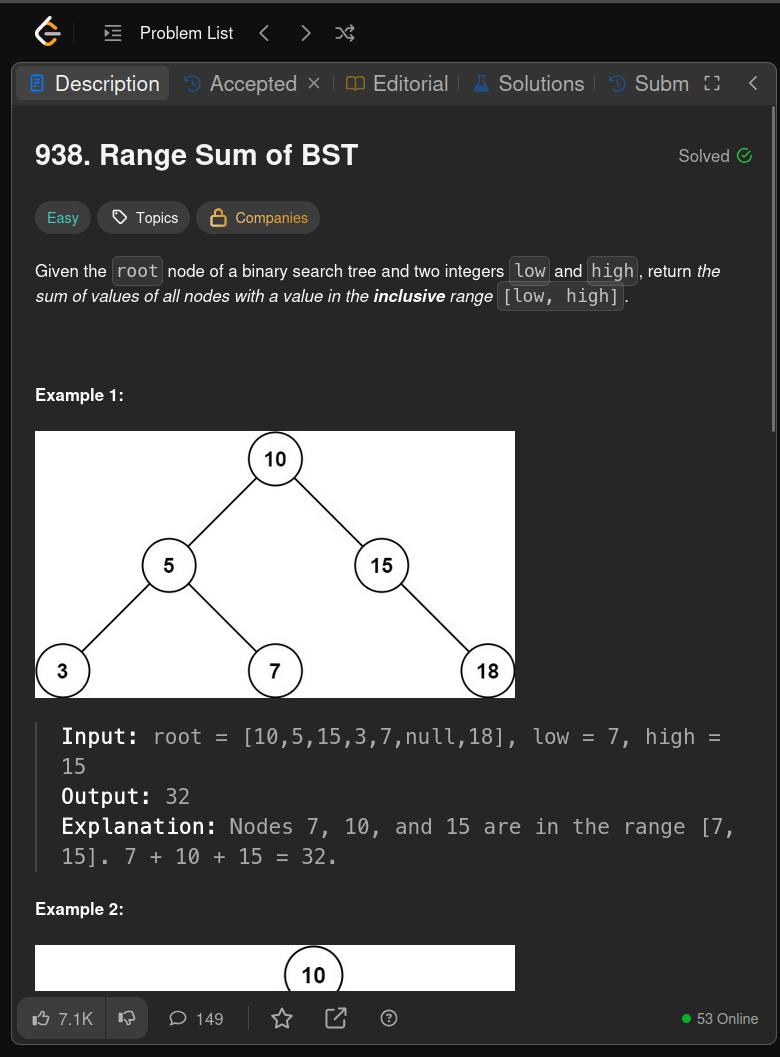
/**
 * Definition for a binary tree node.
 * public class TreeNode {
 *     int val;
 *     TreeNode left;
 *     TreeNode right;
 *     TreeNode() {}
 *     TreeNode(int val) { this.val = val; }
 *     TreeNode(int val, TreeNode left, TreeNode right) {
 *         this.val = val;
 *         this.left = left;
 *         this.right = right;
 *     }
 * }
 */
class Solution {
    public int rangeSumBST(TreeNode root, int low, int high) {
        int ans = 0;
        Stack<Integer> stack = new Stack<>();
        Traverse(root, stack, low, high);
        for(int i:stack)
            ans+=i;
        return ans;
    }
    private TreeNode Traverse(TreeNode root, Stack<Integer> stack, int low, int high){
        if(root==null)
            return null;
        Traverse(root.left, stack, low, high);
        if(root.val>=low && root.val<=high)
            stack.push(root.val);
        Traverse(root.right, stack, low, high);
        return root;
    }
}
Problem 2: Maximum Depth of a Binary Tree
Link to the problem: https://leetcode.com/problems/maximum-depth-of-binary-tree/description/
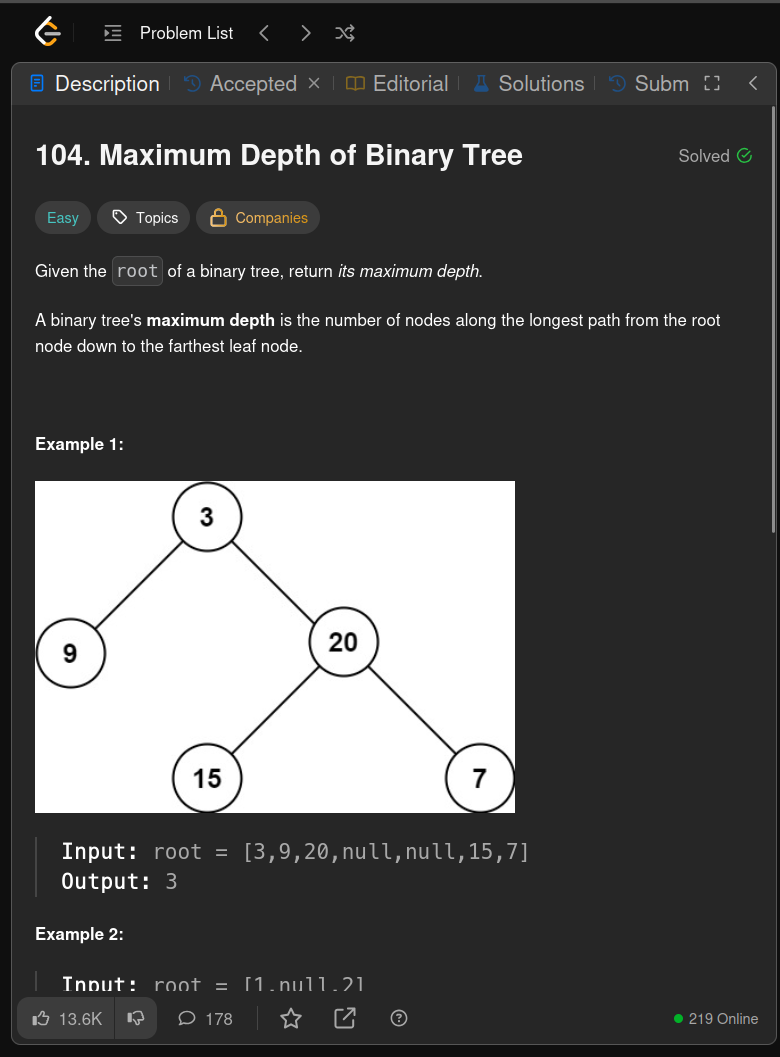
/**
 * Definition for a binary tree node.
 * public class TreeNode {
 *     int val;
 *     TreeNode left;
 *     TreeNode right;
 *     TreeNode() {}
 *     TreeNode(int val) { this.val = val; }
 *     TreeNode(int val, TreeNode left, TreeNode right) {
 *         this.val = val;
 *         this.left = left;
 *         this.right = right;
 *     }
 * }
 */
class Solution {
    public int maxDepth(TreeNode root) {
        if(root==null)
            return 0;
        int left_height = maxDepth(root.left);
        int right_height = maxDepth(root.right);
        return left_height>right_height?left_height+1:right_height+1;
    }
}
Problem 3: SubTree of Another Tree
Link to the problem: https://leetcode.com/problems/subtree-of-another-tree/
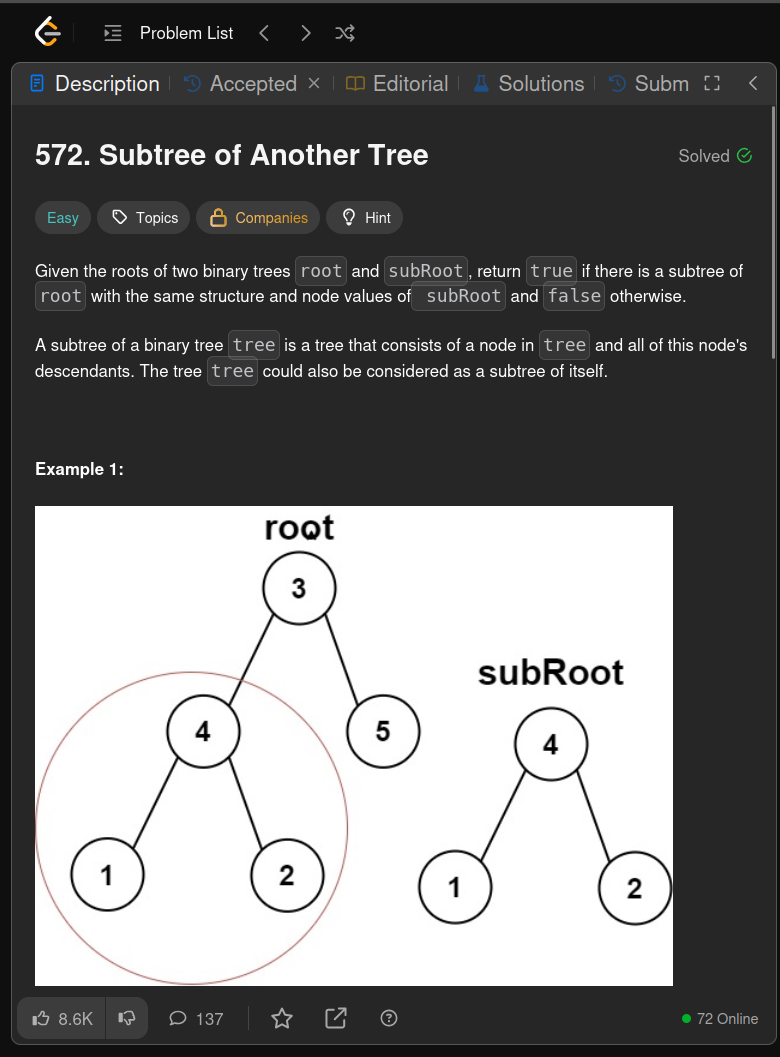
/**
 * Definition for a binary tree node.
 * public class TreeNode {
 *     int val;
 *     TreeNode left;
 *     TreeNode right;
 *     TreeNode() {}
 *     TreeNode(int val) { this.val = val; }
 *     TreeNode(int val, TreeNode left, TreeNode right) {
 *         this.val = val;
 *         this.left = left;
 *         this.right = right;
 *     }
 * }
 */
class Solution {
    private boolean isSameTree(TreeNode p, TreeNode q) {
        if (p == null && q == null) {
            return true;
        }
        if (p == null || q == null) {
            return false;
        }
        if (p.val != q.val) {
            return false;
        }
        return isSameTree(p.left, q.left) && isSameTree(p.right, q.right);
    }

    private boolean helper(TreeNode p, TreeNode q) {
        if (p == null) {
            return false;
        }
        if (isSameTree(p, q)) {
            return true;
        }
        return helper(p.left, q) || helper(p.right, q);
    }

    public boolean isSubtree(TreeNode root, TreeNode subRoot) {
        return helper(root, subRoot);
    }
}
Problem 4: Cousins in Binary Tree
Link to the problem: https://leetcode.com/problems/cousins-in-binary-tree/
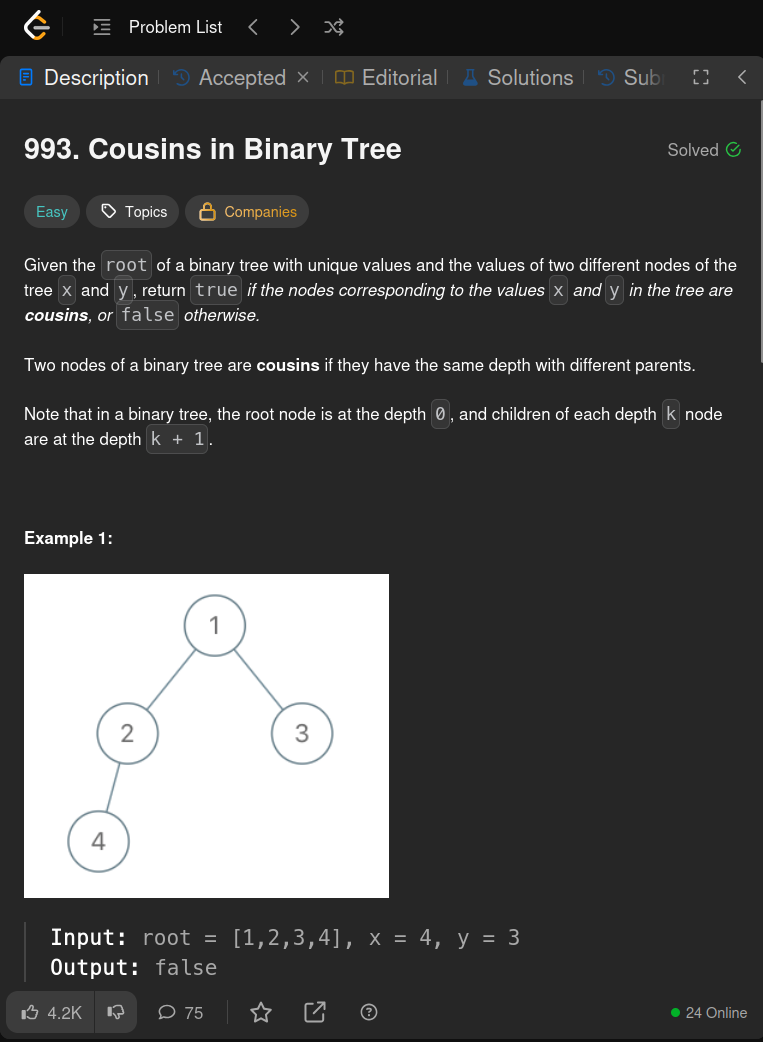
/**
 * Definition for a binary tree node.
 * public class TreeNode {
 *     int val;
 *     TreeNode left;
 *     TreeNode right;
 *     TreeNode() {}
 *     TreeNode(int val) { this.val = val; }
 *     TreeNode(int val, TreeNode left, TreeNode right) {
 *         this.val = val;
 *         this.left = left;
 *         this.right = right;
 *     }
 * }
 */
class Solution {
    static int[] arr = new int[2];
    public boolean isCousins(TreeNode root, int x, int y) {
        int x_depth = findDepth(root, x, 0, 0);
        int y_depth = findDepth(root, y, 0, 1);
        x_depth = arr[0];
        y_depth = arr[1];
        int x_parent = findParent(root, x, 0);
        int y_parent = findParent(root, y, 1);
        System.out.println(arr[0]+" "+arr[1]);
        if(x_depth==y_depth && arr[0]!=arr[1])
            return true;
        return false;
    }
    private int findDepth(TreeNode root, int x, int depth, int num){
        if(root==null)
            return -1;
        if(root.val==x){
            arr[num] = depth+1;
        }
        int left_depth = findDepth(root.left, x, depth+1, num);
        int right_depth = findDepth(root.right, x, depth+1, num);
        return left_depth>right_depth?left_depth+1:right_depth+1;
    }
    private int findParent(TreeNode root, int x, int num){
        if(root==null)
            return 0;
        if((root.left!=null && root.left.val==x) || (root.right!=null && root.right.val==x)){
            arr[num]=root.val;
            return 0;
        }
        findParent(root.left, x, num);
        findParent(root.right, x, num);
        return 0;
    }
}
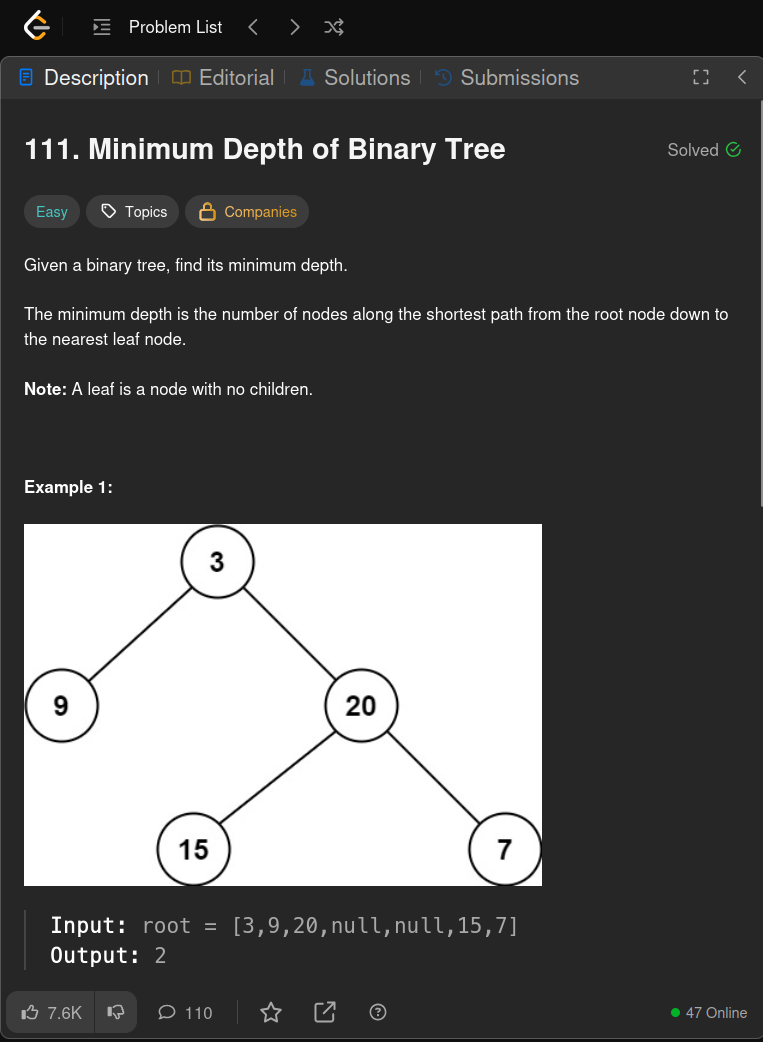
Problem 5: Minimum depth of a Binary Tree
Link to the problem: https://leetcode.com/problems/minimum-depth-of-binary-tree/description/
/**
 * Definition for a binary tree node.
 * public class TreeNode {
 *     int val;
 *     TreeNode left;
 *     TreeNode right;
 *     TreeNode() {}
 *     TreeNode(int val) { this.val = val; }
 *     TreeNode(int val, TreeNode left, TreeNode right) {
 *         this.val = val;
 *         this.left = left;
 *         this.right = right;
 *     }
 * }
 */
class Solution {
    public int minDepth(TreeNode root) {
        Stack<Integer> stack = new Stack<>();
        findDepths(root, stack, 0);
        int ans = Integer.MAX_VALUE;
        for(int i:stack)
            ans=ans<i?ans:i;
        if(ans==Integer.MAX_VALUE)
            ans=0;
        return ans;
    }
    private int findDepths(TreeNode root, Stack stack, int depth){
        if(root==null)
            return 0;
        if(root.left==null && root.right==null)
            stack.push(depth+1);
        else
            findDepths(root.left, stack, depth+1);
            findDepths(root.right, stack, depth+1);
        return 0;
    }
}


